

Introduction
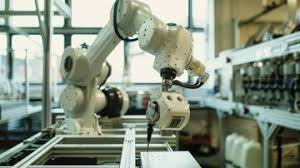
The manufacturing landscape has changed dramatically over the last few decades with perhaps one of the most disruptive technology trends seen to be in robotics. Whether it is in automotive assembly lines, electronics production or food processing plants, robots will soon be an integral part of modern manufacturing. With the need to be efficiency-oriented, low cost and high quality, robotics offers many innovative ways for industries that are changing the design, production and delivery of products.
Enhancing Production Efficiency
The use of robotics in manufacturing has numerous advantages, but one that stands out is the increase in production efficiency. Robots for Automation: Unlike human workers, a robot does not need breaks or refuse to work after a certain hour. This allows manufacturers to scale up production while preserving performance outputs. Automedics are indeed robotic systems that can perform repetitive tasks like welding, assembling, packaging or material handling quickly and accurately. This allows for an even greater mop up of customer demands with reduced production bottleneck and operational lag.
Improving Product Quality and Consistency
For these manufacturing processes it is of utmost importance to keep the product quality consistent. Any small defects would result in customer dissatisfaction, financial losses and also product recalls. Robotics minimizes human error class, they are capable of performing tasks in low times with a high degree of accuracy and repeatability. Robots are programmed to perform in exacting ways, delivering products made with the specifications required for quality assurance. Robots play an essential role in ensuring precision, reducing defects, and improving customer satisfaction and respect for brands within industries like electronics (e.g., semiconductors), pharmaceutical and automotive manufacturing.
Enhancing Workplace Safety
Many manufacturing jobs are performed in challenging environments that expose workers to situations including but not limited to heavy lifting, toxic chemicals, high temperatures and dangerous equipment. One of the best ways that Robotics aids in improving workplace safety is by taking these dangerous duties off your hands. Robots can manipulate materials under extreme conditions, execute operations at high risk for human workers, and operate in confined spaces. Manufacturers are empowering their workforce and reducing workplace injuries, compensation claims, and safer working conditions by minimizing employee exposure to hazardous environments.
Supporting Flexible Manufacturing
Modern consumers are demanding increased variety and personalization in products, hence manufacturers need to be flexible. Modern robotic systems have been developed to respond rapidly to variations in production demand. In contrast to older machines that may require major overhauls, robots can be reprogrammed in a matter of hours with little downtime. This type of flexibility allows manufacturers to alter product lines, personalize products and react quickly to shifts in the market. Consequently, this helps businesses stay competitive in an ever-changing market.
Reducing Operational Costs
Robotic systems require a large initial investment, but the financial return can be enormous over time. It minimizes labors for the repetitive and time-consuming task. Not only that, but robots also use resources more efficiently by eliminating material waste and production errors. Predictable performance and less maintenance means further savings in your bottom line. Through these efficiencies, over time, a good return on investment and much improved bottom line for the manufacturer.
Driving Innovation Through Smart Manufacturing
Rise of smart manufacturing this is a combination of robotics with advanced technologies such as artificial intelligence (AI), machine learning, and the internet of things (IoT)–one leading to another in manufacturing. Smart robots distill real-time data from this process which gives a route to manufacturers to optimize the production processes and makes more informed decisions. The predictive maintenance systems can detect issues with the equipment before its failure, reducing efforts and minimising losses due to downtimes. This is leading to more intelligent manufacturing spaces that are connected, efficient and reactive.
Addressing Workforce Challenges
There are labour shortages in many manufacturing industries and conventional production methods have made it challenging to recruit some skilled workers for repetitive or physically demanding tasks. Robotics also solves this problem by automating repetitive tasks to reduce wastage so that human employees can focus on critical tasks which require creativity like problem-solving, innovation and quality control. Typically, robotics does not take away workforce but empower human exploitation by creating room for more skilled technical individuals and taking positions within the firm that cannot be replaced.
Conclusion
Fundamentally, robotics are redefining industries by making manufacturing more efficient and producing higher-quality products while ensuring greater workplace safety and facilitating innovation. With continual advances in technology, robotic systems will increasingly become smarter, more flexible and affordable for manufacturers of every size. This gives companies adopting robotics a competitive advantage in terms of improved productivity, lower costs, and increased flexibility. Going forward, robotics will continue to transform manufacturing through greater demand responsiveness and more intelligent and sustainable production systems.